
Blockchain gaming in France: ORWL contributes to the 2026 Global Regulatory Report

We are pleased to announce that ORWL_ has contributed the French jurisdictional analysis to the 2026 Global State of Regulations in Blockchain Gaming report, published by the Blockchain Game Alliance (BGA). Our partner William O’Rorke and our associate Imane Dahmani provided their expertise on the evolving regulatory perimeter in France.
As blockchain technology continues to integrate with the global games ecosystem, the industry has become a primary “stress test” for the digital economy. In 2026, interactive environments are no longer viewed merely as products, but as complex systems where tokenized value, user-owned assets, and automated decision-making converge.
Asset classification: economical reality over labels
Under the current legal landscape, the classification of in-game items has shifted from what an asset claims to be to what it actually does. In France, the principle of regulatory subsidiarity applies, focusing on the asset’s economic function and attached rights.
At the highest level of oversight, an in-game asset may qualify as a financial instrument under MiFID II if it confers rights comparable to transferable securities. This includes:
-
Rights to economic returns or yield.
-
Profit participation.
-
Governance powers akin to corporate decision-making.
In line with the approach of the European Securities and Markets Authority (ESMA), assets functioning as investments are regulated as such, regardless of being labeled as “NFTs” or “game items”.
The gambling threshold: a four-step analysis
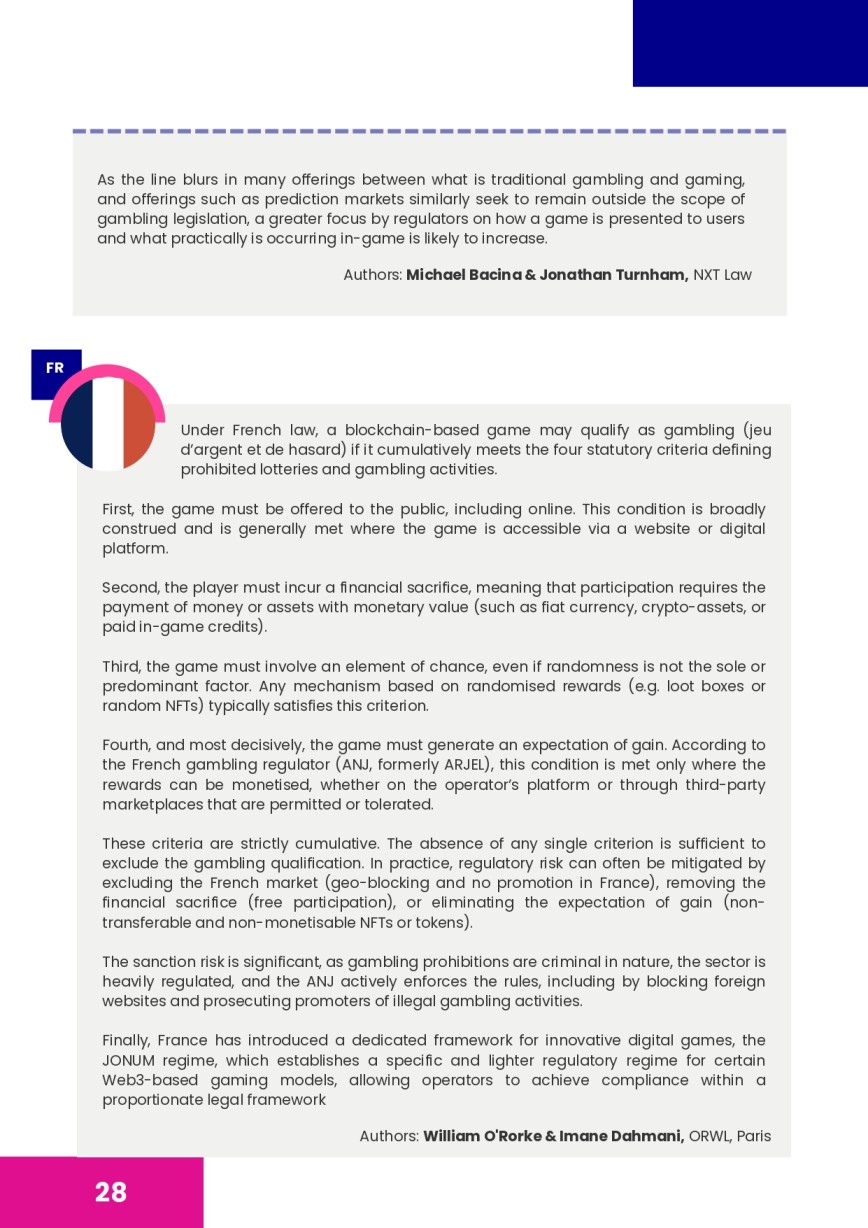
A critical challenge for Web3 developers is determining when randomized mechanics cross into prohibited gambling (jeu d’argent et de hasard). According to the analysis provided by ORWL, a blockchain-based game falls under this classification if it satisfies four cumulative criteria:
-
Offer to the public: The game is accessible via a digital platform, social network/messaging app or website.
-
Financial sacrifice: Participation requires a payment of value, such as fiat, crypto-assets, or paid in-game credits.
-
Element of chance: The rewards are randomized (e.g., loot boxes or random NFT minting).
-
Expectation of gain: This is the decisive factor; rewards must be monetizable, either on the operator’s platform or through tolerated third-party marketplaces.
The French gambling regulator (ANJ) actively enforces these rules. However, the report highlights that risk can be mitigated by removing any single criterion—for instance, by ensuring rewards are non-transferable or that participation is free of charge.
The JONUM Regime: A tailored framework for Web3
To address the specific needs of the sector, France has introduced the JONUM regime (Jeux à Objets Numériques Monétisables). This dedicated framework establishes a lighter, more proportionate regulatory regime for innovative digital games, allowing operators to achieve compliance without the full weight of traditional gambling licenses.
Compliance-by-design as a strategic foundation
As we look toward 2030, the BGA advocates for a structural shift where studios move away from functioning as accidental, unlicensed financial institutions. Success in this new era depends on treating regulation as part of the design process rather than a late-stage hurdle.
Web3 gaming projects seeking to secure their activities and navigate these regulatory requirements are invited to contact us for specialized legal support.
BGA Report : The Regulatory Landscape of Blockchain Gaming