
Presentation of the enhanced DASP registration in France

Article published on 13 March 2023 — update note of 25 October 2026. This article describes the enhanced DASP registration as it stood in 2023. MiCA has governed crypto-asset services since 30 December 2024, and the French transitional period ended on 1 July 2026: a provider now needs authorisation as a crypto-asset service provider (CASP) to serve the French market. For the current procedure, see our page Obtaining CASP authorisation from the AMF.
On 28 February 2023, the French Parliament finally adopted the DDADUE Act (Law No. 2023-171 of 9 March 2023), which creates an enhanced registration regime for digital asset service providers (DASPs). The reform ends a sometimes heated debate between those who wanted to bring forward the MiCA timeline for new DASPs (the regulator and the Government) and the crypto industry, which wanted to keep the timeline set by the European legislator.
In the end, a middle-ground solution prevailed: the final text strengthens the current DASP registration regime. The new regime will only affect new players and will come into force on 1 January 2024. Applicants who have not filed a complete application before 1 July 2023 will no longer be able to obtain a simple registration: they will have to meet the new requirements.
Here are the details of this legislative change and of the new regime.
Why strengthen the regime?
Consolidating the sector after the storm
After the collapse of Terra (LUNA), the bankruptcy of Celsius and the FTX scandal, strengthening the requirements set by the PACTE Act is first and foremost a political response.
Beyond their impact on market confidence and the fraudulent nature of some of these failures, these events exposed the lack of regulation, even though regulation would not, on its own, have prevented the collapse of FTX.
More broadly, this reform follows the spread of crypto-assets among the general public.
A wider and wider adoption of crypto-assets
The stronger regulation also reflects this rapid spread. As early as February 2022, KPMG’s study “La crypto en France” found that 8% of French people had already invested in crypto-assets, whether cryptocurrencies or NFTs, more than the share of French people holding shares directly (6.7% according to the AMF), and that 30% wished to invest.
Against this background, the light-touch DASP registration regime in place since 2019 looks less and less suited, which paves the way for its reinforcement. Behind the scenes, the financial sector, and perhaps the banking sector, is also waiting for rules close to those that apply to it (at the very least MiCA authorisation) before entering this new market.
What changes for market players?
A transitional regime within the MiCA timeline
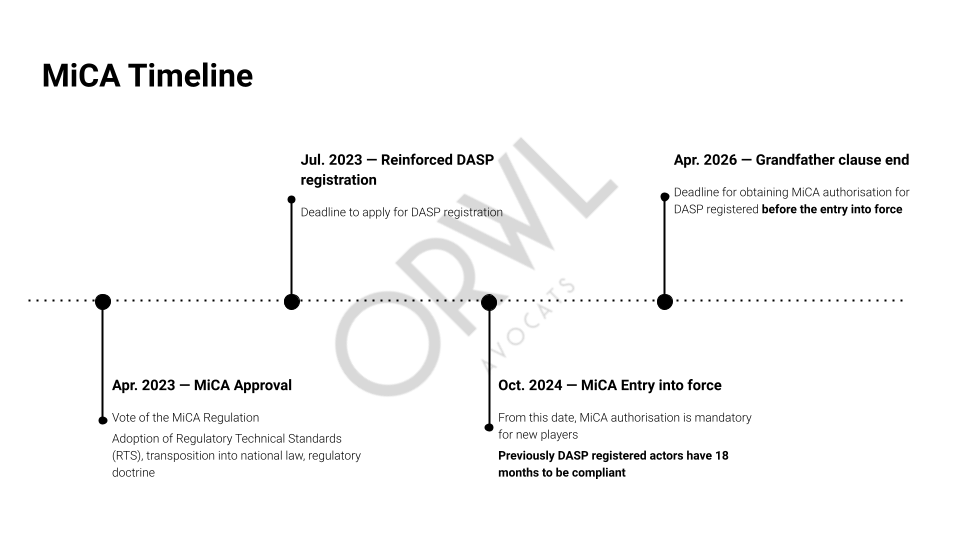
First, the enhanced registration only concerns applicants who have not filed a complete application before 1 July 2023. DASPs that are already registered are not affected by this new regime.
This regime brings forward the timeline of the MiCA Regulation, which should, 18 months after its adoption expected in the coming weeks, apply from the end of 2024:
- unregistered players will have to comply with MiCA as soon as it applies;
- registered players (simple or enhanced) may benefit from an additional period of up to 18 months to comply.
The new enhanced registration therefore sits between the end of the simple registration and the start of MiCA authorisation. To complicate matters further, the optional DASP licence remains available to market players until MiCA actually applies (!).
In practice, what are the new obligations for DASP applicants?
As a reminder, the “simple” registration created by the PACTE Act requires DASPs to comply with anti-money laundering and counter-terrorist financing (AML/CFT) obligations and to show sound management, i.e. the good repute and competence of the company’s managers and beneficial owners.
From 1 January 2024, new DASPs will have to meet, in particular, the following additional obligations:
| Requirement | In practice |
| Have a conflict of interest management system | Depending on the activity (portfolio management in particular), put in place a policy to identify and manage situations likely to give rise to a conflict of interest detrimental to clients. |
| Implement a client complaints handling policy | Inform clients of the complaints handling process and of the options open to them. Keep a complaints register. This policy may be linked to the policy on the exercise of users’ GDPR rights. |
| Communicate in a clear, accurate and non-misleading way, and warn clients of the risks of crypto-assets | The provider’s communications must in particular include a clear and understandable reminder of the risks inherent in crypto-assets (volatility, technological risk…). In practice, this obligation gives the AMF the power to oversee DASP communications, a power so far exercised by the DGCCRF (the French consumer protection authority) under consumer law. Other rules apply to communications on crypto services (the influencer bill currently going through Parliament). |
| Refrain from using clients’ assets without their prior consent | Obtain the client’s express and prior consent before any use of their crypto-assets. |
| Publish a pricing policy | The provider must inform its clients of all fees and costs of its service (for example, account inactivity fees). |
| Where applicable, have a custody policy, segregate clients’ crypto-assets from those the DASP holds on its own account, and allow the prompt return of assets to any client who requests it | For custody and portfolio management services only. |
| Have an internal control system | Put in place internal control measures and procedures to ensure compliance with legal and regulatory obligations, and employ qualified staff for this purpose, in-house or external. |
| Have a resilient and secure IT system | Have physical and IT security arrangements to reduce the risk of attack and manage risks effectively. The provider employs sufficient IT and human resources to ensure the security of its IT system. The AMF is expected to align with the requirements of the DASP licence. |
These requirements partly reproduce those of the DASP licence, which is itself very close to MiCA authorisation.
While some of these obligations are easy to implement, others carry a heavier operational cost:
- the internal control system requires permanent control, entrusted to people dedicated solely to that function, in-house or external;
- the new cybersecurity requirements may call for significant investment from applicants. The AMF should clarify this point in its guidance.
What consequences for the sector?
This reinforcement of the DASP regime calls for three remarks:
- first, it is the first step towards the new standard: MiCA authorisation;
- second, it reflects the fintechisation of the crypto sector: access to the regulated market will become harder and harder, and technical teams will have to rely on financial and legal profiles. Projects will also need to raise significant funds to bear the regulatory cost;
- finally, one may question the point of such a “transitional regime” on the eve of MiCA’s application. Practice shows how hard it is for the sector and the regulators to keep up with regulatory change. The risk that enhanced registration turns into a bureaucratic maze is real, all the more so as the legislator gives no guarantee on this point…
Article written with Germain Chaux, trainee lawyer.