
EMT dual licensing: study by William O’Rorke (RDBF)

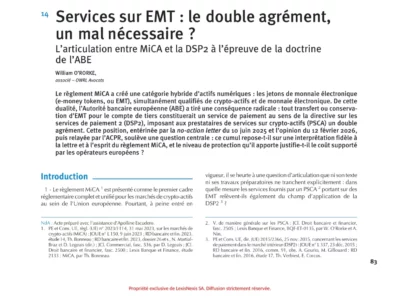
The Revue de droit bancaire et financier, a French banking and financial law review, published in its issue 5 of 15 October 2026 a study by William O’Rorke, the partner in charge of ORWL Avocats’ Regulatory practice, on the dual licensing required of crypto-asset service providers (CASPs) that transfer or hold e-money tokens (EMTs) for clients. The study argues that the European Banking Authority (EBA) has turned Article 48 of MiCA, a provision on issuance, into a classification rule that the Regulation does not lay down.
Reference
William O’Rorke, “Services sur EMT : le double agrément, un mal nécessaire ? L’articulation entre MiCA et la DSP2 à l’épreuve de la doctrine de l’ABE” (in French), Revue de droit bancaire et financier, LexisNexis, No 5, September-October 2026, dossier 14, pp. 83-86, released 15 October 2026. Subscribers only.
Is an EMT electronic money for every transaction?
Article 48(2) of Regulation (EU) 2023/1114 (MiCA) deems EMTs to be electronic money. In the author’s view, this rule serves issuance: it sits in Title VI, applies Titles II and III of Directive 2009/110/EC to issuers, and requires them to be authorised as a credit institution or an electronic money institution. Article 3, which defines EMTs, treats them only as crypto-assets.
The EBA reasons differently, in its no-action letter of 10 June 2025 and its Opinion of 12 February 2026: an EMT is electronic money, PSD2 lists electronic money among “funds”, and transferring funds on behalf of others is a payment service. The ACPR (Autorité de contrôle prudentiel et de résolution, the French banking supervisor) adopted this reading on 19 February 2026, for EMT transfers and for EMT custody where the wallet can send and receive tokens.
The study raises three objections. The reasoning confuses the nature of the asset with the classification of the transaction. Recitals 90 and 93 are drafted in conditional terms and have no binding force (CJEU, 24 November 2005, Case C-136/04). Neither Article 59 nor Article 60 of MiCA makes EMT services subject to payment institution authorisation, and no exemption comparable to the one that Article L. 314-1, III, 2° of the French Monetary and Financial Code (CMF) grants investment firms protects CASPs from the overlap.
What payment institutions and compliance teams should take away
The deadlines set by the EBA and the ACPR have passed: 2 March 2026 for most CASPs, and 1 July 2026 for those under the French transitional regime of Article 143(3) of MiCA, which covers former PSANs (registered under the French pre-MiCA regime). A CASP that transfers or holds EMTs for clients must now hold payment institution authorisation or rely on an authorised payment service provider. Otherwise, it risks an order to cease these services.
Such partnerships open a line of business for payment institutions. For CASP compliance teams, the ACPR limits the cost by accepting that own funds be pooled. The increase mainly affects CASPs subject to €50,000 of initial capital, which move to €125,000 under the streamlined payment institution authorisation for CASPs. The governance PSD2 requires and joint supervision by the AMF (Autorité des marchés financiers, the French financial markets regulator) and the ACPR come on top.
The study called on the legislator to settle the issue in PSD3 and the Payment Services Regulation (PSR), preferably by adding the relevant requirements to MiCA. According to analyses of the compromise texts published by the Council on 23 April 2026, the co-legislators did not take that route: the PSR excludes EMT exchange but keeps custody and transfer on behalf of clients within its scope. It does, however, let institutions authorised under PSD3 provide certain EMT services on simple notification. For projects where payments dominate, ORWL Avocats now weighs this route against dual licensing. As at 16 October 2026, neither text had been adopted.
double agrement emt rdbf extrait p83
View in the publisher’s website
EMT services to classify?
ORWL Avocats assesses whether the EMT flows of a CASP or a payment institution fall under PSD2, and handles payment institution applications before the ACPR, including the streamlined procedure for CASPs.
You can also talk to a partner.
Dual CASP and payment institution status: when crypto needs ACPR authorisation